Master / Bedroom
Master Bedroom Ideas: How to Design a Room That Actually Feels Like a Retreat
A master bedroom usually gets the most square footage in the house and the least design attention — it becomes the room where the leftover furniture ends up, arranged by default rather than by decision. The gap between a bedroom that just holds a bed and one that feels like a retreat is almost never about square footage; it's about giving the room a clear focal point, at least one zone that isn't for sleeping, and light that isn't a single overhead fixture.
Try this in my room — freeUpload a photo of your room · 1 free watermarked preview a month · no account · How AI bedroom design works
None of that requires new furniture. It requires rearranging and layering what you already have — which also makes it the easiest room in a rental to upgrade, since nothing below touches a wall permanently.
The palette
- Warm ivory
- Fog grey
- Deep navy
- Antique brass
- Dusty rose
Anchor the room on one focal wall
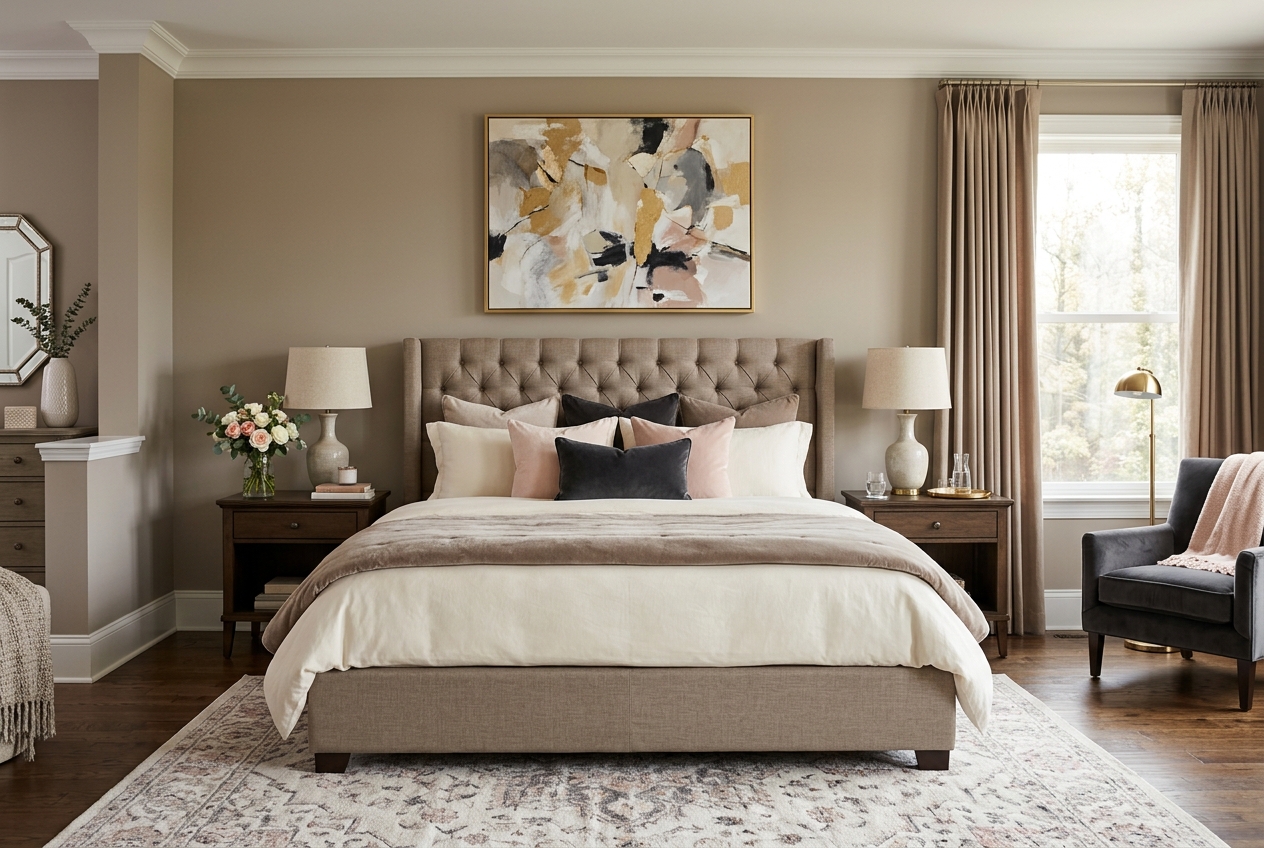
Pick the wall the bed sits against and commit to it as the room's single focal point: center the bed, flank it with matching nightstands and lamps, and hang art or a mirror centered above the headboard. This kind of symmetry is what separates a "hotel room" feel from a dorm-room one, and it costs nothing if you already own the pieces — it is purely a placement decision. Every other wall in the room should feel secondary to this one.
Carve out a zone that has nothing to do with sleeping
A master bedroom earns the name when part of it is not about the bed — a reading chair by the window, a bench at the foot of the bed, or a small desk in an unused corner. If you already own a chair or bench living elsewhere in the apartment, this is often just a matter of moving it in and giving it its own small rug or lamp so it reads as a distinct zone rather than storage overflow.
Layer three light sources instead of one
A single ceiling fixture flattens a large room and makes it feel more like an office than a retreat. Add a lamp on each nightstand, one more in the secondary seating zone, and — if you have one — a dimmer on the overhead light. The goal is to be able to light only the bed, only the reading corner, or the whole room, depending on what you are doing in it.
Scale your textiles up, not just your bed
A larger room swallows a standard-size rug and short curtains, which is why master bedrooms often feel oddly under-furnished even with a big bed in them. Size the rug to extend well past the sides and foot of the bed, and hang curtains from just below the ceiling rather than the top of the window frame — both moves make the whole room feel intentionally scaled rather than sparse.
See it in your own room for free
Upload a photo of your room, pick a style, and compare a redesign made with instructions to keep your room layout. No signup needed.
Redesign my room freeSee how Roomcast redesigns your actual roomOr get Roomcast on iPhone1 free watermarked preview a month. Premium on iPhone: $4.99/week with a 3-day free trial, $6.99/month, or $29.99/year with a 3-day free trial.
FAQ
What makes a bedroom feel like a master suite instead of just a bigger bedroom?
A clear focal wall with symmetrical nightstands and lighting, at least one zone dedicated to something other than sleeping (reading chair, bench, small desk), and layered lighting instead of a single overhead fixture. Square footage alone does not create the retreat feeling — the zoning and light do.
How should I arrange furniture in a large primary bedroom?
Center the bed on one wall to establish it as the focal point, then use remaining furniture — a dresser, bench, or chair — to define a second zone elsewhere in the room rather than scattering pieces evenly around the perimeter. Symmetry around the bed and a clear second zone read as designed rather than default.
Can I see master bedroom ideas applied to my actual room?
Yes — Roomcast turns a photo of your real primary bedroom into a redesign that keeps your existing walls, windows, and furniture in place, so you can see a focal-wall layout and lighting plan applied to your own space before moving anything.