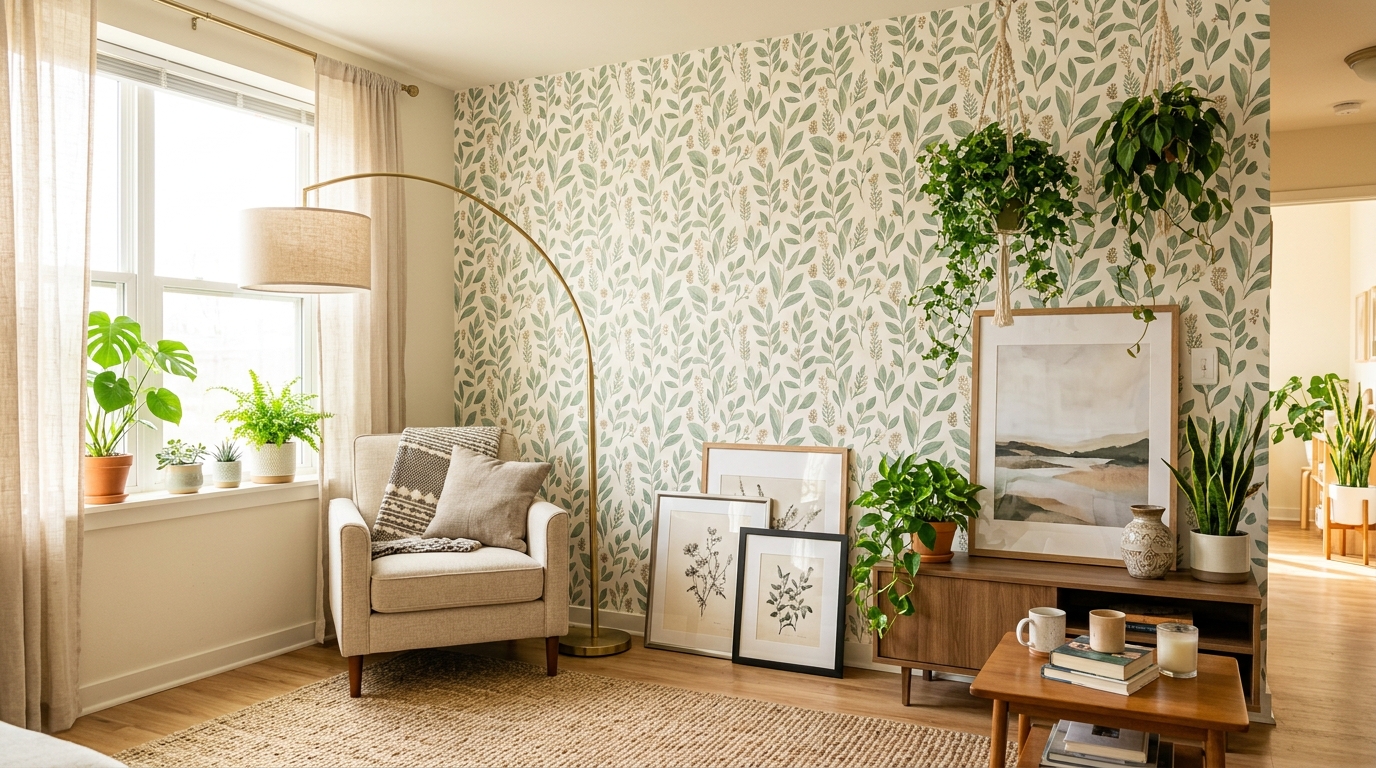
Renting shouldn’t mean living with a space you didn’t choose and can’t change. But most interior design inspiration — Pinterest boards, home magazines, even a lot of AI redesign tools — assumes you can paint any wall, drill anywhere, or knock down a partition. If you’re renting, that’s often not true, and the redesign you fall in love with can be useless if it depends on changes your lease doesn’t allow.
What “renter-friendly” actually means in practice
It’s not a fixed rulebook — every lease is different — but most renter-friendly redesign advice centers on a few categories of change that are reversible, don’t require landlord sign-off in most standard leases, and don’t put your deposit at risk if done carefully:
- Furniture and layout — rearranging what you already have, or adding new pieces, changes a room’s whole feel without touching a single wall.
- Lighting — swapping bulbs, adding floor and table lamps, or using plug-in sconces instead of hardwired fixtures.
- Soft furnishings — rugs, curtains, throw pillows, and bedding are some of the highest-impact, lowest-risk changes you can make.
- Removable wall treatments — peel-and-stick wallpaper, tile, and decals are designed to come off cleanly, though it’s worth testing a small patch first and checking your lease.
- Command-strip mounted decor — art, mirrors, and shelving that use adhesive strips instead of nails avoid wall damage entirely.
What’s usually not renter-friendly without explicit permission: painting walls, installing permanent fixtures, removing or altering built-in cabinetry, and any electrical or plumbing work.
Where an AI redesign app fits into this
An AI room design app is useful here for one specific reason: it lets you see a style direction applied to your actual room before you spend money on anything. You take a photo of your bedroom or living room, pick a style, and get a redesigned version showing what that direction could look like.
The catch is that not every app distinguishes between “paint the walls a new color” and “add a rug and rearrange the furniture” — some redesigns will show you a room with different wall color or built-in shelving that assumes changes a renter can’t make. When evaluating the result, mentally separate what’s achievable (furniture, rugs, lighting, removable decor) from what isn’t (structural or painted changes), and use the redesign as a style reference rather than a literal shopping list.
A practical workflow for renters
- Take a clear photo of the room as it is now, in good lighting, with the whole space visible if possible.
- Generate a redesign in your preferred style. Look at what changed — furniture, colors, textures, layout — and note which of those are things you can actually do (buy a rug, rearrange furniture, add lighting) versus things that assume permanent changes.
- Check your lease or ask your landlord about anything you’re unsure of, especially wall treatments, even removable ones.
- Shop the achievable parts of the look — furniture, rugs, curtains, lighting — rather than trying to recreate every element of the generated image exactly.
How Roomcast fits renters specifically
Roomcast’s Keep room layout mode asks the model to preserve the room structure and furniture placement while restyling the space. Creative redesign can explore a bolder arrangement, so renters should treat every generated result as visual guidance and verify proposed changes against the lease. Pricing is $6.99/month or $29.99/year, and you can see your first result before deciding whether to upgrade.
See it in your own room for free
Upload a photo of your room, pick a style, and compare a redesign made with instructions to keep your room layout. No signup needed.
Redesign my room freeSee how Roomcast redesigns your actual roomOr get Roomcast on iPhone1 free watermarked preview a month. Premium on iPhone: $4.99/week with a 3-day free trial, $6.99/month, or $29.99/year with a 3-day free trial.
Bottom line
The gap between a redesign you love and a redesign you can actually live in usually comes down to whether it respects what a lease allows. Use an AI redesign app for style direction, filter for the reversible changes, and always double-check anything ambiguous with your landlord before you commit.
See it in your own room for free
Upload a photo of your room, pick a style, and compare a redesign made with instructions to keep your room layout. No signup needed.
Redesign my room freeSee how Roomcast redesigns your actual roomOr get Roomcast on iPhone1 free watermarked preview a month. Premium on iPhone: $4.99/week with a 3-day free trial, $6.99/month, or $29.99/year with a 3-day free trial.
Keep exploring: room ideas, all Roomcast alternatives compared, or redesign your own room free.