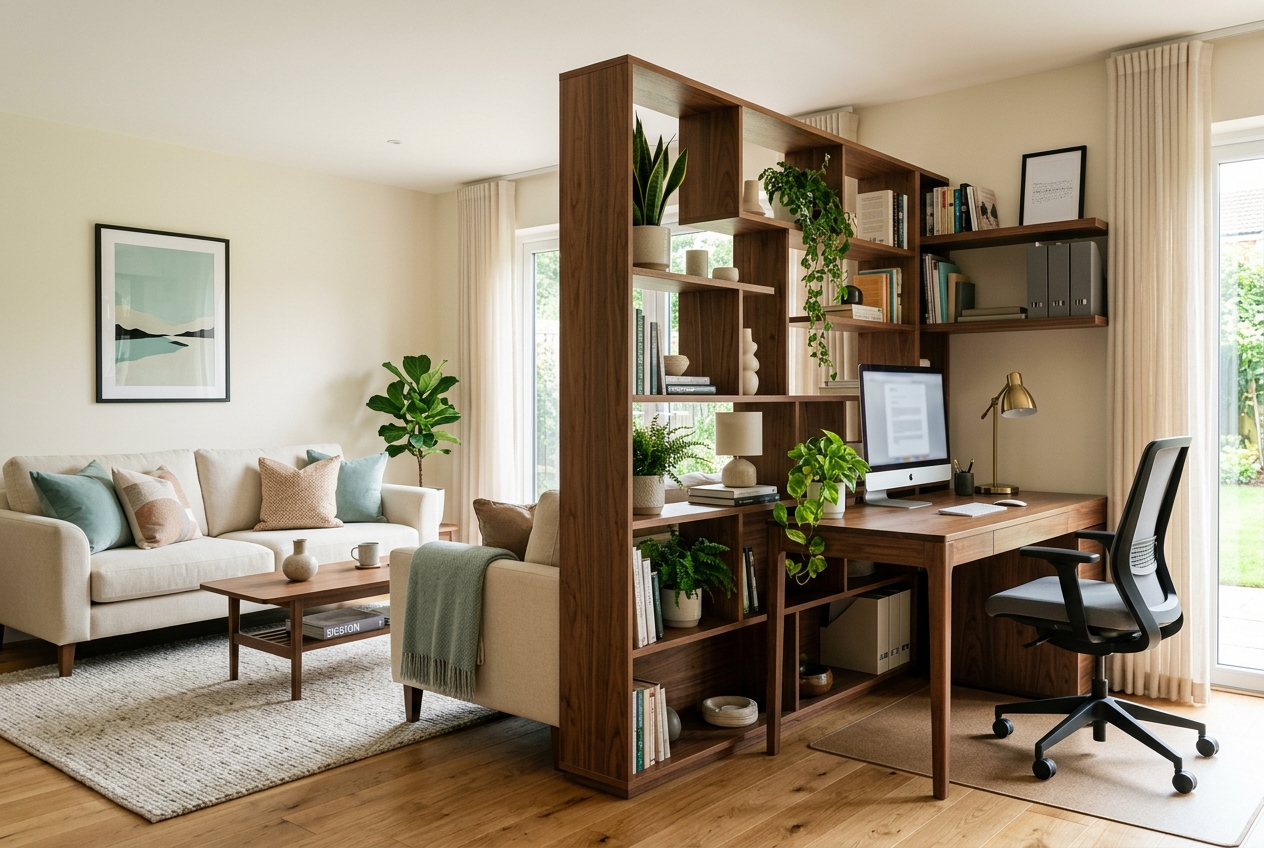
Dual-Purpose / Living Room
Living Room and Office Combination Ideas: Making One Room Do Both Jobs Well
A desk-in-the-corner solves where the work happens, but a true living room and office combination is a bigger design problem: the same room has to switch identities twice a day, look like a living room the moment a video call starts, and not slowly turn into a permanent home office that swallows the sofa. That is less about furniture placement and more about designing two distinct "modes" for one room.
Try this in my room — freeUpload a photo of your room · 1 free watermarked preview a month · no account · How AI living room design works
The rooms that pull this off share a few habits: they define what changes between modes, they treat the camera's view of the room as a design constraint, and they put work supplies behind doors rather than on open shelves.
The palette
- Warm white
- Fog grey
- Deep navy
- Brass
- Walnut
Decide what actually changes between "work mode" and "evening mode"
A room that stays in permanent work mode is what makes a combination feel like an office that happens to have a couch, rather than a living room that happens to have a desk. Pick two or three things that switch at the end of the workday — the laptop closes and goes into a drawer, a lamp swaps from a bright task bulb to a warm one, a throw comes off the back of the desk chair and onto the sofa — so the room visibly clocks out along with you.
Design the wall behind the desk as a video-call backdrop, on purpose
Whatever is behind you on a call becomes part of how the room reads to other people, so that wall deserves the same styling attention as the rest of the living room, not a forgotten stretch of blank space or a cluttered bookshelf. A few intentional objects, one piece of art, and a plant read as "considered living room" on camera; a visible charging cable jungle or laundry pile reads as "makeshift office" no matter how nice the rest of the room is.
Keep office supplies behind doors, not on open shelves
Open shelving displays whatever is on it, which works for books and objects but turns a printer, a stack of folders, or a tangle of cables into visible clutter the moment they are set down. A cabinet, a lidded basket, or a credenza with doors lets the same storage capacity exist in the room without it reading as "office supplies" every time someone looks at that wall.
Choose furniture that already does double duty
A credenza that holds a printer on one side and serves as a media console on the other, an ottoman with storage inside that also works as a footrest during movie night, or a dining table used as a desk by day all let one piece serve both identities instead of adding office-specific furniture that only earns its keep during work hours. Furniture with a single obvious job is what starts to make the "office" half feel like it is competing with the "living room" half for the same square footage.
See it in your own room for free
Upload a photo of your room, pick a style, and compare a redesign made with instructions to keep your room layout. No signup needed.
Redesign my room freeSee how Roomcast redesigns your actual roomOr get Roomcast on iPhone1 free watermarked preview a month. Premium on iPhone: $4.99/week with a 3-day free trial, $6.99/month, or $29.99/year with a 3-day free trial.
FAQ
How do I make my living room look like a living room on video calls, not an office?
Treat the wall behind your desk as a designed backdrop — a piece of art, a plant, and one or two intentional objects — and keep visible clutter like cables and paperwork out of that sightline. What is behind you on camera matters more than what the rest of the room looks like.
What is the best way to combine a home office and a living room?
Define what changes between work mode and evening mode (lighting, a closed laptop, a swapped throw), store office supplies in closed storage rather than open shelving, and choose furniture that can serve both a work and a living-room purpose rather than adding office-only pieces.
Can I see how a living room and office combination would look in my actual space?
Yes — Roomcast redesigns a photo of your real living room while keeping your existing furniture and layout, so you can preview a work-and-living combination — including what the video-call backdrop would look like — in your own room before rearranging anything.